The world’s coral reefs, often referred to as the "rainforests of the sea," are facing unprecedented threats from climate change, ocean acidification, and human activities. As these vital ecosystems decline, scientists and conservationists are turning to innovative techniques to restore them. Among the most promising methods is the use of coral nurseries combined with underwater grafting—a process that mimics natural coral growth to accelerate reef regeneration.
Coral nurseries are underwater farms where fragments of healthy corals are cultivated before being transplanted onto degraded reefs. These nurseries provide a controlled environment where corals can grow without the immediate pressures of predation, disease, or sedimentation. Once the corals reach a suitable size, they are carefully grafted onto damaged reef structures, kickstarting the recovery of the ecosystem.
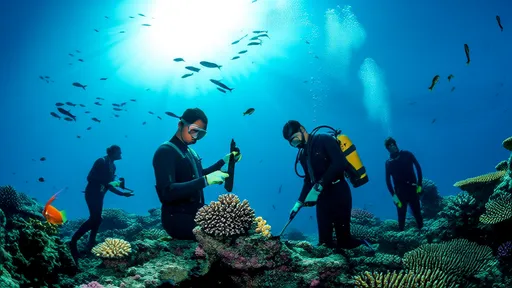
The grafting process itself is a delicate operation. Divers collect small fragments of resilient coral species, often those that have demonstrated resistance to higher temperatures or disease. These fragments are then attached to artificial structures or existing reef frameworks using non-toxic adhesives or biodegradable ties. Over time, the corals grow and fuse with the reef, creating a seamless integration that encourages further natural recruitment of marine life.
One of the key advantages of this approach is its scalability. Unlike large-scale artificial reef projects, which can be costly and logistically challenging, coral nurseries and grafting allow for targeted interventions. Local communities and conservation groups can manage these nurseries with relatively simple equipment, making the technique accessible even in remote or resource-limited regions.
Success stories are already emerging from projects around the globe. In the Caribbean, where staghorn and elkhorn corals have suffered dramatic declines, underwater grafting has helped revive once-barren reefs. Similarly, in the Philippines and Indonesia, community-led coral nurseries have restored fishing grounds and bolstered coastal protection against storms. These efforts not only benefit marine biodiversity but also support the livelihoods of millions who depend on healthy reefs.
However, challenges remain. Coral grafting requires ongoing monitoring to ensure the transplanted fragments survive and thrive. Predation by fish, competition with algae, and sudden environmental shifts can all jeopardize success. Moreover, while grafting can speed up reef recovery, it is not a silver bullet. Addressing the root causes of reef decline—such as reducing carbon emissions and curbing overfishing—remains critical to long-term conservation.
Despite these hurdles, the potential of coral nurseries and underwater grafting is undeniable. By combining cutting-edge science with community engagement, this technique offers a beacon of hope for reefs on the brink. As research continues to refine the methods and improve survival rates, the dream of revitalizing our oceans’ most vibrant ecosystems grows ever more attainable.
The Science Behind Coral Grafting
Coral grafting leverages the natural ability of corals to reproduce asexually through fragmentation. In the wild, broken coral pieces can reattach to substrates and grow into new colonies. Scientists have harnessed this trait by deliberately fragmenting healthy corals and nurturing them in nurseries. The process not only accelerates growth but also allows for the selection of hardier genotypes that can withstand environmental stressors.
Recent advancements in marine biology have further optimized grafting techniques. For instance, researchers are experimenting with microfragmentation—a method where corals are cut into tiny pieces to stimulate rapid growth. When these microfragments are placed close together, they grow and merge, forming a larger colony in a fraction of the time it would take naturally. This innovation is particularly valuable for slow-growing species that would otherwise take decades to recover.
Community Involvement: A Cornerstone of Success
The role of local communities in coral restoration cannot be overstated. In many coastal regions, fishermen and divers are trained to maintain nurseries and perform grafting operations. This not only empowers communities to take ownership of reef conservation but also provides alternative livelihoods in ecotourism or reef monitoring. Projects that integrate traditional knowledge with scientific expertise often achieve the most sustainable outcomes.
Educational programs are also crucial. By raising awareness about the importance of reefs and the threats they face, conservationists foster a sense of stewardship among younger generations. Schools in reef-dependent areas are increasingly incorporating marine ecology into their curricula, ensuring that the next generation is equipped to protect these ecosystems.
Looking Ahead: The Future of Reef Restoration
As coral grafting techniques evolve, so too does the ambition of restoration projects. Large-scale initiatives are now exploring the use of robotics and AI to monitor nurseries and optimize transplantation sites. Meanwhile, international collaborations are pooling resources and knowledge to tackle reef degradation on a global scale.
The urgency of these efforts cannot be ignored. With scientists predicting that up to 90% of coral reefs could vanish by mid-century, the window for action is closing. Yet, the progress made through coral nurseries and grafting offers a glimmer of hope. By working with nature rather than against it, humanity may yet preserve the breathtaking beauty and ecological richness of coral reefs for generations to come.
By /Jul 7, 2025
By /Jul 7, 2025
By /Jul 7, 2025
By /Jul 7, 2025

By /Jul 7, 2025
By /Jul 7, 2025
By /Jul 7, 2025
By /Jul 7, 2025
By /Jul 7, 2025
By /Jul 7, 2025
By /Jul 7, 2025
By /Jul 7, 2025
By /Jul 7, 2025
By /Jul 7, 2025
By /Jul 7, 2025
By /Jul 7, 2025
By /Jul 7, 2025
By /Jul 7, 2025
